

Twelve Years of Showing Up: Honoring Our San Diego Community


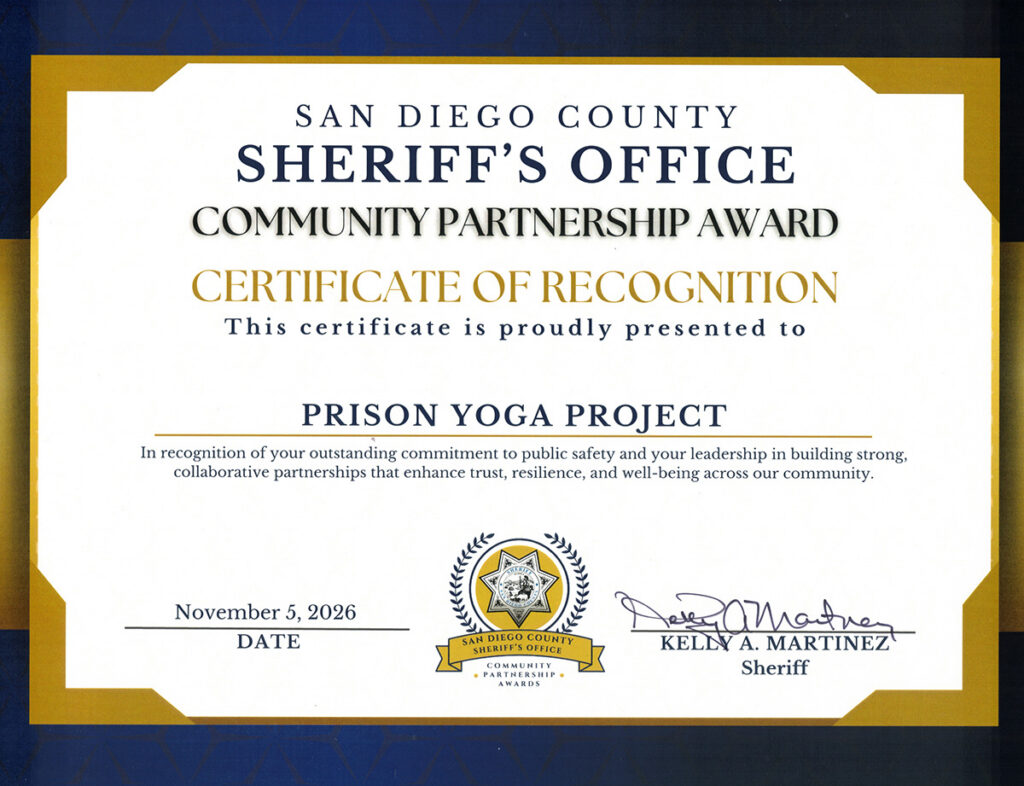
On November 5, Lisa Urbanek and I accepted a Certificate of Recognition on behalf of Prison Yoga Project at the San Diego County Sheriff’s Community Partnership Awards. Standing alongside Lisa, a longtime San Diego facilitator and supporter, I thought about how many people helped bring us to that moment.
For twelve years, our facilitators have walked through the doors of San Diego County jails, offering opportunities to practice, connect, and discover the possibility of change. This recognition belongs to that whole community.
At the ceremony, Sheriff Kelly A. Martinez expressed an idea that resonates deeply with our work:
“I view public safety as inseparable from community well-being.”
Our partnership with the Sheriff’s Office is one way that idea takes shape: through people coming together to support the healing and well-being of those who are incarcerated, knowing that their lives remain connected to families, neighborhoods, and communities beyond the walls.
Opening the Door
Our partnership with the Sheriff’s Office began in 2014 with programs in the veterans modules at Vista Detention Facility. Those programs are among the longest-running programs in Prison Yoga Project. Over the years we have offered programs in every detention facility run by the office, including in the administrative segregation unit at the George Bailey Detention Center.
Grace Liu, who was working with the San Diego County District Attorney’s Office and volunteered as a PYP facilitator, helped open the door by connecting us with the Sheriff’s Office. California’s public safety realignment under Assembly Bill 109 had shifted responsibility for certain sentences from state prisons to county jails, creating new demands for local rehabilitative programming.
During that period, we witnessed the Reentry Services Division team expand their work beyond administrative responsibilities, developing community partnerships and creating more opportunities for people in custody. Patricia Ceballos, Rebecca Cardenas, and the Reentry Services Division team at the Sheriff’s Office have been instrumental in that work. Their commitment helped make space for programs like ours.
We are also grateful, in particular, to Reentry Counselor Michael Barragan who nominated PYP for this recognition. His nomination reflects the relationships that have sustained this partnership over the years.
A Community Behind Every Class
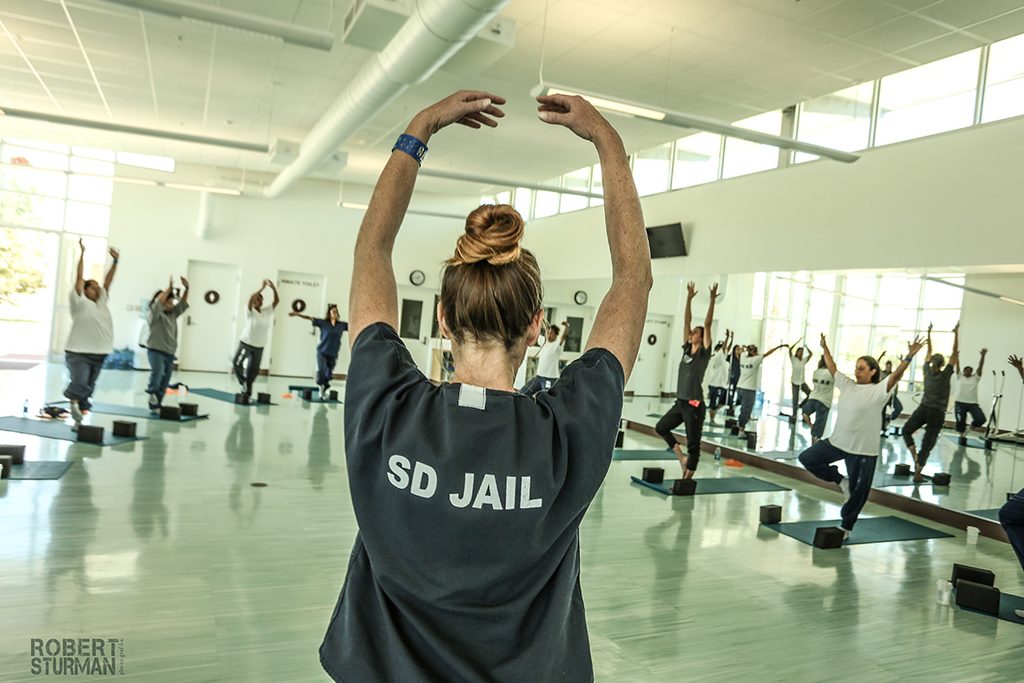
Across twelve years, dozens of facilitators have contributed their time, skill, and care to our programs in San Diego County jails. They have prepared practices, traveled to facilities, navigated security procedures, adapted to changing schedules, and returned week after week. They have offered participants choices, listened to their experiences, and welcomed people into a practice where their dignity matters.
Our work across San Diego County is sustained by a dedicated facilitation team, supported by California Program Manager Gabrielle Blue. We gratefully acknowledge our current team—Lisa Urbanek, Jacque Crawford, Paige Jennings, Maria Eckley, Jenn Smidt, Sofia Weber, Leah Roschke, and Jayme LaForte—and all those who have worked alongside us over the years for their contributions to this community.
Today, our partnership with the San Diego County Sheriff’s Office supports five programs across Las Colinas, East Mesa, and Vista Detention and Reentry Facilities, with another program pending at Vista.
Our countywide service also includes two programs at Richard J. Donovan Correctional Facility and one at East Mesa Juvenile Detention Center, where two additional programs are pending. We are also working toward restarting two paused programs at Naval Consolidated Brig Miramar.
Together, this team carries forward a shared commitment to making trauma-informed yoga and embodied mindfulness available to people throughout the region.
We cannot always know what someone carries away from a class. Occasionally, we get to see.
The Possibility in a Single Practice
I remember meeting a man at San Diego Central Jail who had been living on the streets and was experiencing intense anxiety. He told me that he spent his days pacing around the housing unit, trying to exhaust himself enough to sleep at night. During lockdowns, when he could no longer pace, he would sit in his cell and shake.
By the end of our first session together, his energy had shifted. When I asked what he might do the next time the facility went on lockdown, he began demonstrating the standing sun salutations we had practiced.
I looked forward to seeing him the following week. He wasn’t there. He’d been transferred to another facility.
Months later, I was substituting in the veterans program at Vista. A man approached me, placed his hand on my shoulder, and looked me in the eye. It took me a moment to recognize him.
He was calm and clear-eyed. It was the same man.
He smiled broadly and told me that yoga had changed his life.
Another former participant in San Diego shared his experience in a Facebook discussion about our program. Before his incarceration, he had experienced homelessness, struggled with addiction, and become disconnected from his family. He wrote that meeting our facilitators at East Mesa Detention and Reentry Facility—and experiencing the kindness they offered—had inspired him to change his life.
A year after his release, he reported that he was sober, employed, and reunited with his family.
The work of making those changes belonged to him. Our facilitators had offered something he could draw upon: a practice, a connection, and an experience of being treated with care.
What We Make Possible Together
These experiences remind us why sustained access matters. Each class creates another opportunity for someone to discover a way to meet anxiety, experience connection, or begin to imagine a different future.
Making that opportunity available takes a community. It takes counselors who advocate for programming, staff who help make programs possible, facilitators who return with patience and care, and supporters who sustain the work. It takes participants willing to try something unfamiliar and make the practice their own.
To everyone who has been part of our San Diego programs over these twelve years: this recognition belongs to you.
Thank you for opening doors, building relationships, and continuing to show up. The care you offer can travel with someone long after a session ends—into a difficult night, a moment of choice, a return home, or a renewed relationship with family.
That is a possibility worth showing up for.
Help Us Keep Showing Up
For twelve years, our community has helped bring healing, connection, and hope to people incarcerated in San Diego County. Your gift helps us continue showing up, week after week, offering practices and support that can make a difference long after someone leaves the classroom.
Make a gift today and help keep these opportunities available.
Responses