

From 15 Years Behind Bars to a New Vision for Rehabilitation in Indonesia

By Örjan Elovsson, Aspiring PYP Facilitator and Practitioner
How a book, a personal journey and a shared vision are opening the door to a potential Prison Yoga Project pilot programme in Jakarta.
My name is Örjan Elovsson. I am serving a life sentence at Cipinang Class I Prison (Lapas Kelas I Cipinang), Jakarta, Indonesia. I have already served 15 years, living with the uncertainty of what my future holds. Will I ever be free again, or will I remain behind bars until the end of my life?
Over these 15 years, I have had to find my own ways of maintaining my mental and physical well-being. Recently, I came into contact with Prison Yoga Project and received the book It’s an Inside Job. I would not say that discovering Prison Yoga Project introduced me to an entirely new path. Instead, it helped me understand something fundamental about the path I have already been walking.
When I began reading the book, I read it from cover to cover in just a few days. As I explored its practices, I recognised many things that had already been part of my life in prison, although I had not necessarily approached them in the way the book describes.
For the first time, I began to understand more clearly why these things had mattered so much.
Finding Structure When Hope Is Scarce
Life in prison presents challenges that are difficult to understand fully unless you have experienced them yourself. Many prisoners struggle with mental health difficulties, trauma, personal problems and the emotional weight of an uncertain future. For those serving life sentences or facing the possibility of a death sentence, the burden can be particularly heavy.
In an environment where hope can be scarce, finding a sense of purpose becomes essential.
Over the years, I have developed routines that have helped me maintain my well-being and find meaning in everyday life. Meditation has been one part of that journey. Strength training has been another. I have also found purpose in teaching at the prison school and taking part in educational projects there.
I have also taken responsibility for caring for a growing group of cats. Today, there are 27.
These activities may seem unrelated, but for me, they share something important: they give my days structure, provide a sense of responsibility and remind me that I can still create something meaningful, even within the limitations of prison life.
Reading It’s an Inside Job helped me recognise the importance of these routines in a new way. It also showed me that there are additional practices I can explore to strengthen my motivation, improve my mental well-being and continue developing as a person.
The book has not only helped me understand how I have managed to get through the past 15 years. It has also given me new ideas about how I can move forward.
Looking Back to Move Forward
During my years in prison, I have also written a book about my life. Gräsodlaren, published by Lind & Co and co-authored with Tobias Landehag, explores my life experiences and the consequences of the choices I have made.
Looking back at your own life can be difficult. It requires honesty, reflection and a willingness to confront parts of yourself that you might otherwise prefer to avoid. But I have come to understand how important that process can be.
Reflection allows us to examine our experiences, understand our behaviour and begin to see ourselves differently. In that sense, I recognise a connection between my own journey and some of the principles explored in It’s an Inside Job: the possibility of working from within to support personal growth, rehabilitation and well-being.
These ideas became the starting point for a conversation that would eventually lead to something much bigger.
From a Personal Conversation to a Shared Vision
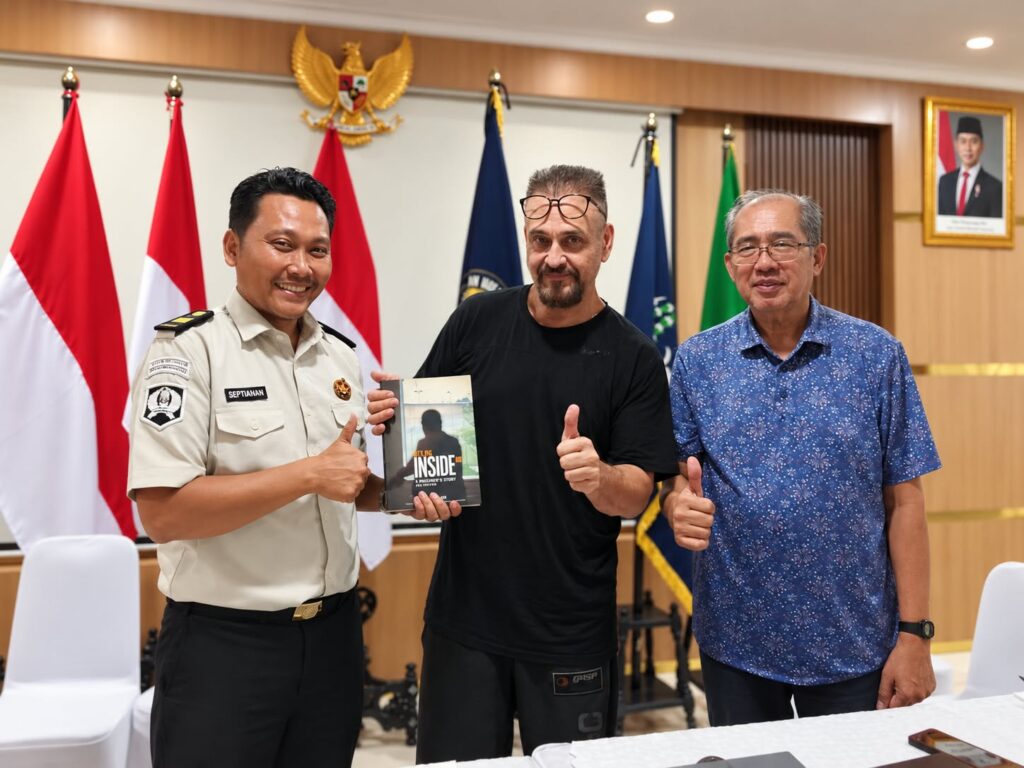
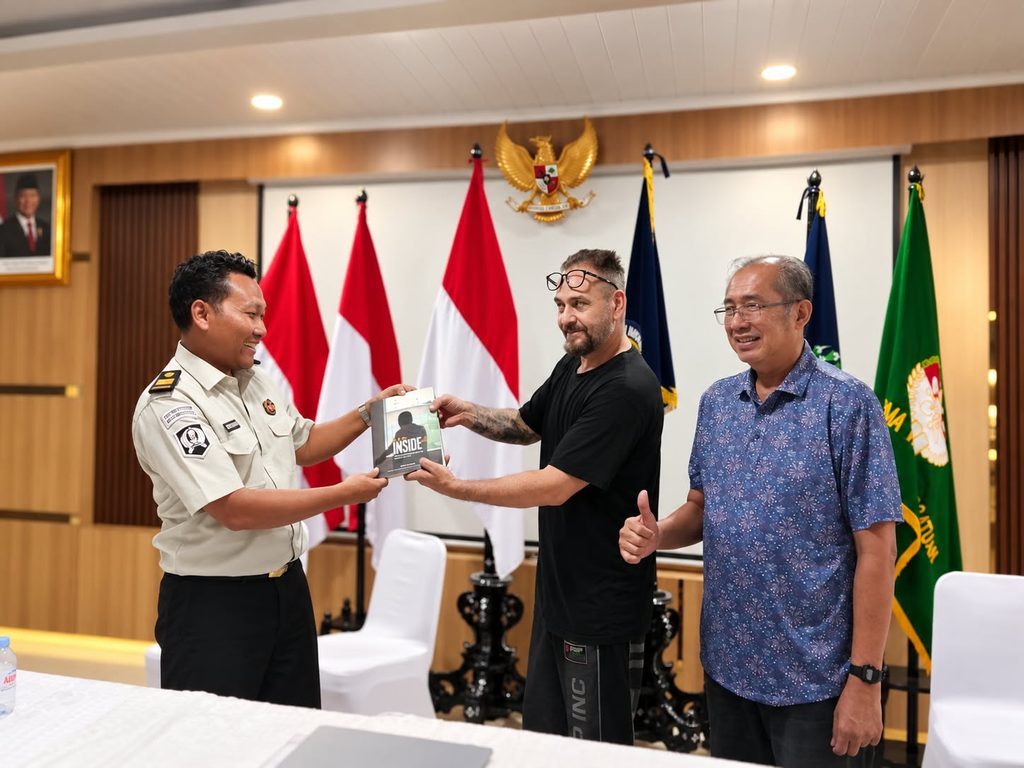
One day, during a conversation with Josefin Wikström, we began discussing whether Prison Yoga Project could offer a meaningful path forward for me and for other prisoners in Indonesia.
The more we discussed the possibilities, the clearer it became that this was something worth exploring.
We took the idea to Pak Septiyawan at Cipinang Prison and arranged a Zoom meeting to discuss the details, the practical possibilities and the vision for a future Prison Yoga Project programme at the prison where I am serving my sentence.
During these discussions, we also considered the potential role of the prison’s leadership, including the prison warden, Dr. Syarpani. The idea was to explore whether a programme could be developed to help prisoners better understand their own mental capacities, address emotional difficulties and discover practical ways to support their well-being.
These conversations were an important step forward. There is still much to work through, and we understand that turning an idea into a functioning programme requires patience, planning and cooperation. We are approaching the future with enthusiasm, but also with humility and a realistic understanding of the challenges ahead.
Nevertheless, the opportunity is real, and the potential is significant.
A Possibility for Prisoners Beyond Jakarta
For me, this initiative is about more than introducing a book or a set of practices into a prison.
It is about recognising that prisoners remain human beings with the capacity to learn, reflect, change and develop. A prison sentence does not remove the need for mental well-being, nor does it remove a person’s need for purpose and hope.
I have experienced how simple practices, consistent routines and a sense of responsibility can help me navigate life behind bars. I have also experienced the value of having something constructive to work towards, even when so much of my future remains outside my control.
I believe that other prisoners could benefit from having access to tools that help them explore these possibilities for themselves.
If we can establish a successful pilot programme in Jakarta, it may provide an opportunity to explore how this approach could reach prisoners in other institutions across Indonesia, where many people face their own struggles with trauma, mental health and the challenges of incarceration.
The Work Begins Within
Receiving It’s an Inside Job has given me something I did not fully expect: a deeper understanding of my own journey and a renewed vision for the future.
After 15 years in prison, I know how important it is to find ways of maintaining your mental and physical health when your circumstances offer few opportunities for control. I also know that what helps one person survive can sometimes become something that helps others find their own way forward.
I cannot change the years I have spent behind bars, and I cannot predict what my own future will hold. But I can use what I have learned to contribute to something meaningful.
That is why I am looking forward to the possibility of introducing and practising Prison Yoga Project in Indonesia.
What began with a book and a conversation has developed into a shared vision for a potential pilot programme. If we can turn that vision into reality, we may be able to offer other prisoners practical tools for finding greater stability, self-awareness and hope.
For me, that would be an opportunity worth working towards.
Sometimes, the first step towards changing a person’s circumstances is helping them discover what is still possible within themselves.
Responses