Ten Weeks of Yoga, Lasting Change
Research from a women’s correctional facility reveals how trauma-informed yoga and mindfulness foster healing, belonging, and resilience.
For more than 25 years, Paula Pierolivo Rodriguez has worked alongside communities impacted by trauma, violence, and marginalization around the world. A bilingual advocate, yoga and mindfulness teacher, and longtime volunteer, Paula has spent the past three years facilitating trauma-informed yoga and mindfulness classes with incarcerated women at a high-security correctional facility in New England. As part of a master’s program in trauma-informed wellness education, she recently conducted a ten-week research project exploring the impact of yoga and mindfulness on participants’ stress levels, sense of belonging, and emotional resilience. What she discovered confirms what many participants have shared with Prison Yoga Project for years: when people are offered consistent opportunities to connect with their bodies, breath, and one another, meaningful change becomes possible.
By Nicole Hellthaler, Executive Director
At Prison Yoga Project, we often hear stories about the impact of yoga and mindfulness inside correctional facilities. At Prison Yoga Project, participant feedback helps guide and strengthen our work every day. This project allowed us to complement those lived experiences with formal research.
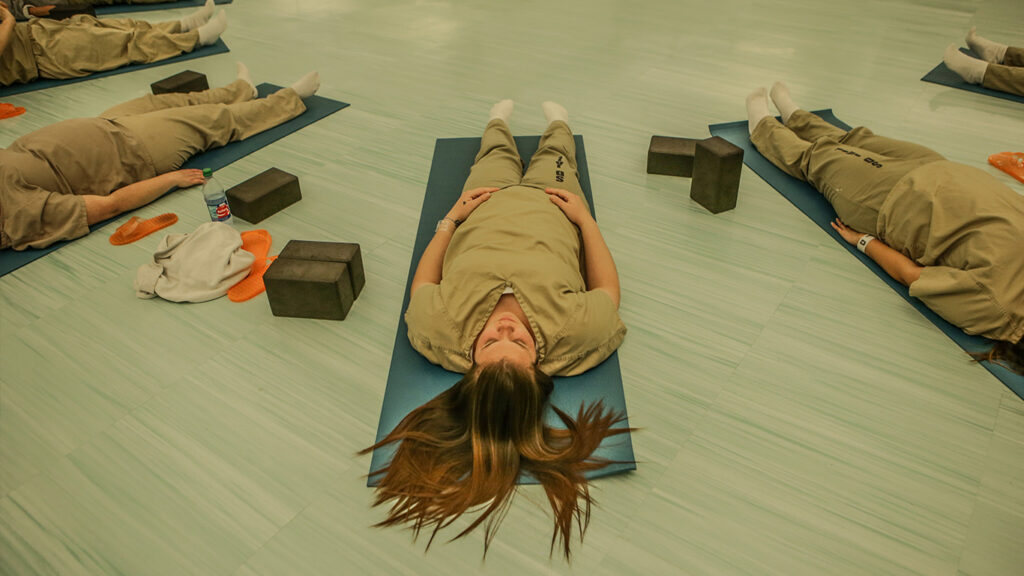
Last year, Prison Yoga Project facilitator Paula Pierolivo Rodriguez conducted a 10-week Yoga and Mindfulness Immersion Program with a group of women incarcerated at a high-security correctional facility in the Northeastern United States. The program combined trauma-informed yoga, breathwork, meditation, reflection, and independent study using Prison Yoga Project’s Yoga and Mindfulness Immersion Workbook.
What Paula set out to measure was straightforward: Could a consistent yoga and mindfulness practice reduce stress, strengthen emotional resilience, and increase a sense of belonging among participants?
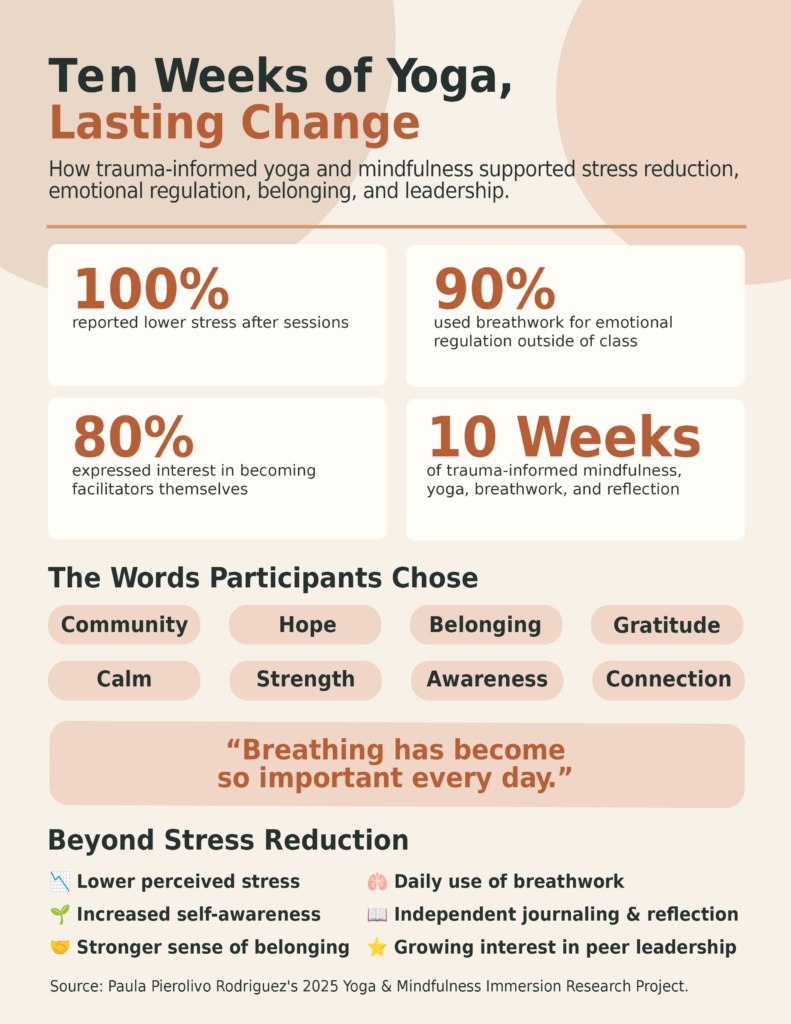
The answer was a resounding yes.
Throughout the ten-week program, participants reported measurable decreases in perceived stress and overwhelming increases in their ability to regulate emotions through breath and mindfulness practices. Many began using these tools outside of class, integrating breathing exercises, meditation, stretching, and journaling into their daily lives.
But the most meaningful findings weren’t found in a chart.
They were found in the words participants used to describe their experience:
“My anger goes away when I am here.”
“I feel more relaxed.”
“Breathing has become so important every day.”
“When I feel overwhelmed, I can practice in my own space.”
One participant shared that they arrived carrying the weight of the day, but left feeling they had “let go of a lot of what I was carrying.”
Another reflected on something many of us take for granted: the simple act of stopping to breathe.
Across the program, participants repeatedly identified breathwork as the most valuable tool they learned. For women living in an environment defined by stress, uncertainty, and limited autonomy, the ability to regulate their nervous systems through breathing became an accessible source of stability and self-care.
Just as significant was the sense of community that emerged.
Each class began with a simple check-in where participants shared two words describing how they felt. Over time, words like hope, gratitude, belonging, and community surfaced again and again.
For many participants, healing was not only happening within themselves. It was happening between them.
Attendance steadily increased throughout the program despite the realities of life inside a correctional facility, where lockdowns, medical appointments, and security events can disrupt even the most carefully planned schedules. As word spread, more women expressed interest in joining.
And perhaps the most surprising outcome emerged halfway through the program.
Participants weren’t just interested in continuing their own practice.
They wanted to teach.
By the fifth week, most participants expressed interest in one day becoming facilitators themselves. The program was no longer simply providing tools for individual well-being; it was planting seeds of leadership.
For Paula, this represents the future of trauma-informed programming inside correctional facilities.
“When participants step into the role of facilitators, the cycle of healing comes full circle.”
At Prison Yoga Project, we often say that healing happens in relationship. This research reinforces what we have witnessed for years inside prisons and jails across the country: when people are offered consistent opportunities to connect with their bodies, regulate stress, and practice self-awareness in community, meaningful change becomes possible.
Not because yoga fixes everything.
But because it helps people reconnect with strengths they already possess.
The women who participated in this program left with more than a certificate of completion. They left with practical tools, stronger connections, and a growing belief in their own capacity to heal, grow, and contribute to the well-being of others.
That is the kind of transformation that extends far beyond a classroom.
It ripples outward into relationships, families, communities, and ultimately, into the world we all share.
Responses